

The war in Iran is being sold to the public as another self-contained Middle Eastern emergency, the latest installment in a script audiences have been conditioned to recognize. The familiar ingredients are all present: a hostile regime, missile salvos, retaliatory strikes, oil-market panic, breathless warnings of escalation, and experts assuring viewers that this crisis—like so many before it—can be understood within the borders of the region itself. It fits neatly inside the post-9/11 mindset Americans have lived under for two decades: urgent, dangerous, dramatic, but ultimately local. That framing is comforting because it is familiar. It is also deeply misleading. It describes the violence while obscuring the significance. It explains the event while missing the era now taking shape behind it. It is almost as if Orwell were scripting the narrative: “The Party told you to reject the evidence of your eyes and ears. It was their final, most essential command.”
My education in policy analysis, while formal, was shaped through a lens of experience. As a Marine Special Operations Raider, I served in Iraq during the campaign to retake Mosul from ISIS in 2017, and several other strategic areas of operation one would not consider a “flashpoint”. As you look at operations through an intelligence cycle lens, you learn to think differently about problem sets. You think root cause. You think second and third order effects—You think —cost benefit analysis. America sets its sites on areas years in advance to influence and shape wars, conflicts, populations and narratives.
War teaches many of us lessons not always obvious to the lay reader: Local battlefields are rarely local. What appears to be a fight over one city, one militia, or one insurgent group is usually tied to larger networks of money, ideology, borders, state weakness, and great-power interests operating in the background. Tactical victories matter, but they do not erase strategic realities. That perspective shapes how I see Iran now—not as an isolated conflict, but as one theater inside a much wider contest.
The wars that have bestowed our generation and our children’s generation a lifetime of debt and despair may just be the beginning. What may be unfolding is not merely another conflict in a volatile region, but the visible edge of a larger strategic transition that has been building for years. The United States is gradually shifting away from the habits of the post-Cold War period and toward a renewed logic of great-power competition. If that is true, then the war in Iran is not an isolated fire. It is one front in a broader reordering of American priorities.
To understand why, it is necessary to revisit the original doctrine of containment. After the Second World War, the United States confronted a transformed global landscape. Europe was devastated, Britain was exhausted, colonial empires were fading, and the Soviet Union had emerged with enormous military reach and ideological ambition. Washington faced a rival capable of reshaping Eurasia if left unchecked. The solution was not immediate war. It was strategic patience.
Containment, as articulated by George Kennan and later institutionalized through the Truman Doctrine, the Marshall Plan, NATO, and a network of alliances, aimed to prevent further Soviet expansion while strengthening the economic and political foundations of the Western world. It accepted that some territory had already been lost and that victory would not be immediate. Its strength lay in time. The United States would preserve the balance, absorb pressure, and allow the internal contradictions of the Soviet system to accumulate.
Eventually, in 1989, they did.
The Soviet Union collapsed not because of one decisive battle, but because it could not sustain the cumulative burdens imposed by military competition, technological lag, economic stagnation, imperial overstretch, and ideological exhaustion. Containment worked because it was broader than war. It was political, economic, military, psychological, and patient.
That historical memory matters, because the United States now faces a different kind of challenger: China is not the Soviet Union. It is not a sealed land empire with a brittle command economy cut off from world markets. China rose through globalization rather than against it. It became the world’s factory, one of its largest trading states, a technological competitor, a maritime builder, and the central node in many industrial supply chains. Where Soviet power threatened territory, Chinese power can threaten systems.That distinction is crucial.
The old containment lines ran through Berlin, Korea, and the Fulda Gap. The new lines run through Taiwan, the South China Sea, Hormuz, Panama, semiconductor fabrication plants, undersea cables, rare earth supply chains, and strategic ports. The contest is no longer centered only on armies crossing borders. It is centered on whether one power can dominate the networks on which the modern world depends. That is the essence of Containment 2.0.
Instruments of Power
Another useful way to understand Containment 2.0 is through the framework known as DIME-FIL, a modern shorthand for the instruments of national power: Diplomatic, Informational, Military, Economic, Financial, Intelligence, and Law-enforcement/Legal tools.
Great powers rarely rely on military force alone. They combine pressure across multiple domains to shape adversary behavior without requiring constant open war. In the case of Iran, those combined pressures look like:
Diplomacy managed via Gulf partners and negotiations over nuclear limits;
Informational power shaping narratives around escalation and legitimacy;
Military power exhibited through naval deployments, air defense, deterrence strikes, and regional posture;
Economic power operating through sanctions and trade restrictions;
Financial tools targeting payment networks, insurers, banks, and illicit revenue streams;
Intelligence capabilities mapping proxy networks, weapons flows, and internal vulnerabilities;
Legal instruments like maritime seizures, sanctions enforcement, export controls, and international resolutions.
What makes Containment 2.0 distinct from older models is that success is measured less by battlefield conquest than by the coordinated use of these levers to constrain rivals, raise their costs, diminish their options, and preserve strategic freedom for larger contests elsewhere—most notably with China.
For much of the last two decades, many policymakers assumed China’s rise was inevitable. Its population was immense, its manufacturing capacity unrivaled, its growth rates spectacular, and its foreign reserves enormous. Through the Belt and Road Initiative, Beijing appeared to be extending its influence across continents by financing ports, railways, roads, pipelines, industrial zones, and digital infrastructure. It looked like the quiet construction of a new world order.
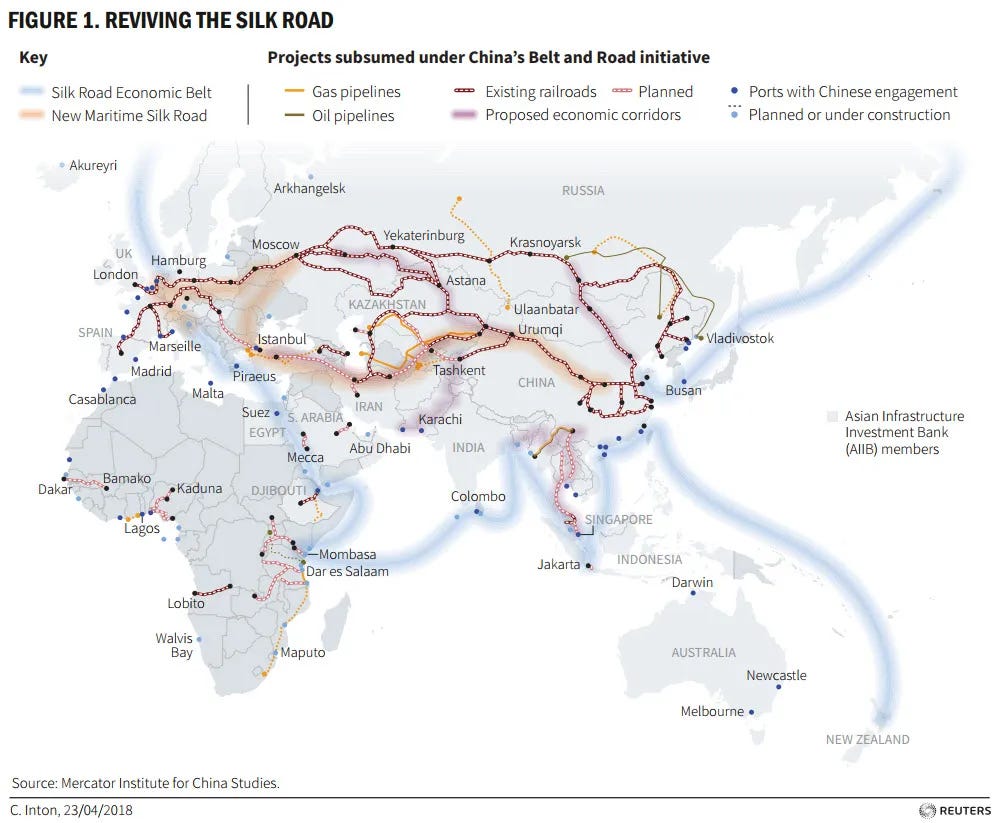
Yet still, China’s expanding scale and influence abroad were masking increasingly difficult realities at home.
China now faces structural constraints that complicate the image of unstoppable ascent. Its property sector, once a driver of household wealth and local-government finance, has shown serious weakness. Debt burdens have grown. Youth unemployment became politically sensitive enough to unsettle official reporting practices. Most importantly, the demographic engine that powered decades of growth has begun to reverse. Population decline has started, fertility remains low, and the long shadow of the one-child era is now colliding with aging, workforce contraction, and rising dependency costs.
Demography is rarely dramatic, but it is deeply strategic. Nations draw power from labor pools, tax bases, military-age cohorts, housing demand, and long-term consumption. A shrinking and aging population imposes harder tradeoffs on any state, especially one attempting military modernization while sustaining high growth.
The United States faces demographic pressures of its own, but it retains one advantage often underestimated in geopolitical analysis: immigration. America can replenish labor, talent, entrepreneurship, and population in ways China cannot easily replicate. While the U.S. can still attract ambitious people from around the world, China must try to persuade exhausted urban families to have more children. That difference may prove more consequential than many short-term military comparisons.
Striking while the iron is still hot
When states sense structural constraints, they often move to secure external advantages while time is still on their side. They seek out resources, diversify supply routes, build strategic buffers, and strive to reduce vulnerabilities before their internal pressures deepen. This helps explain the urgency behind Chinese activity across Africa, Latin America, the Gulf, and maritime Asia.
Energy lies at the center of that urgency.
China’s vulnerability is not that it lacks industrial power. It is that industrial power at Chinese scale requires vast imported energy flows. Oil and gas must move across chokepoints such as the Strait of Hormuz, the Indian Ocean, and the Strait of Malacca before reaching Chinese ports and refineries. Any disruption in those arteries threatens growth, stability, and strategic confidence. To Western audiences, Iran is typically framed through ideology, proxy warfare, nuclear ambitions, and hostility toward Israel or the United States. Those dimensions are real, but they are not the whole picture. Iran is also an energy node. It offers hydrocarbon reserves, discounted crude under sanctions conditions, and a willing partner outside Western political frameworks. For Beijing, Iran has been useful precisely because it operates in gray zones where normal market constraints are weaker.
Pressure on Iran is aimed directly at China through Containment policy.
When the United States uses sanctions, interdictions, naval presence, or blockade dynamics against Iran, the effects move outward through tanker routes, insurance markets, freight costs, refinery margins, and replacement demand. The pain reaches China indirectly. Iran is therefore not only a regional adversary. It is a leverage point inside a larger strategic contest.
That same logic extends eastward into the South China Sea, where the next major geopolitical flashpoint may be taking shape.
Too often described as a quarrel over reefs and cartography, the South China Sea is in reality a struggle over trade routes, undersea resources, fisheries, surveillance depth, naval access, and political precedent. Roughly one-third of global maritime trade passes through these waters. Major energy flows bound for East Asia transit nearby routes. The Spratly Islands and surrounding zones matter because small physical features can anchor much larger legal and military claims.
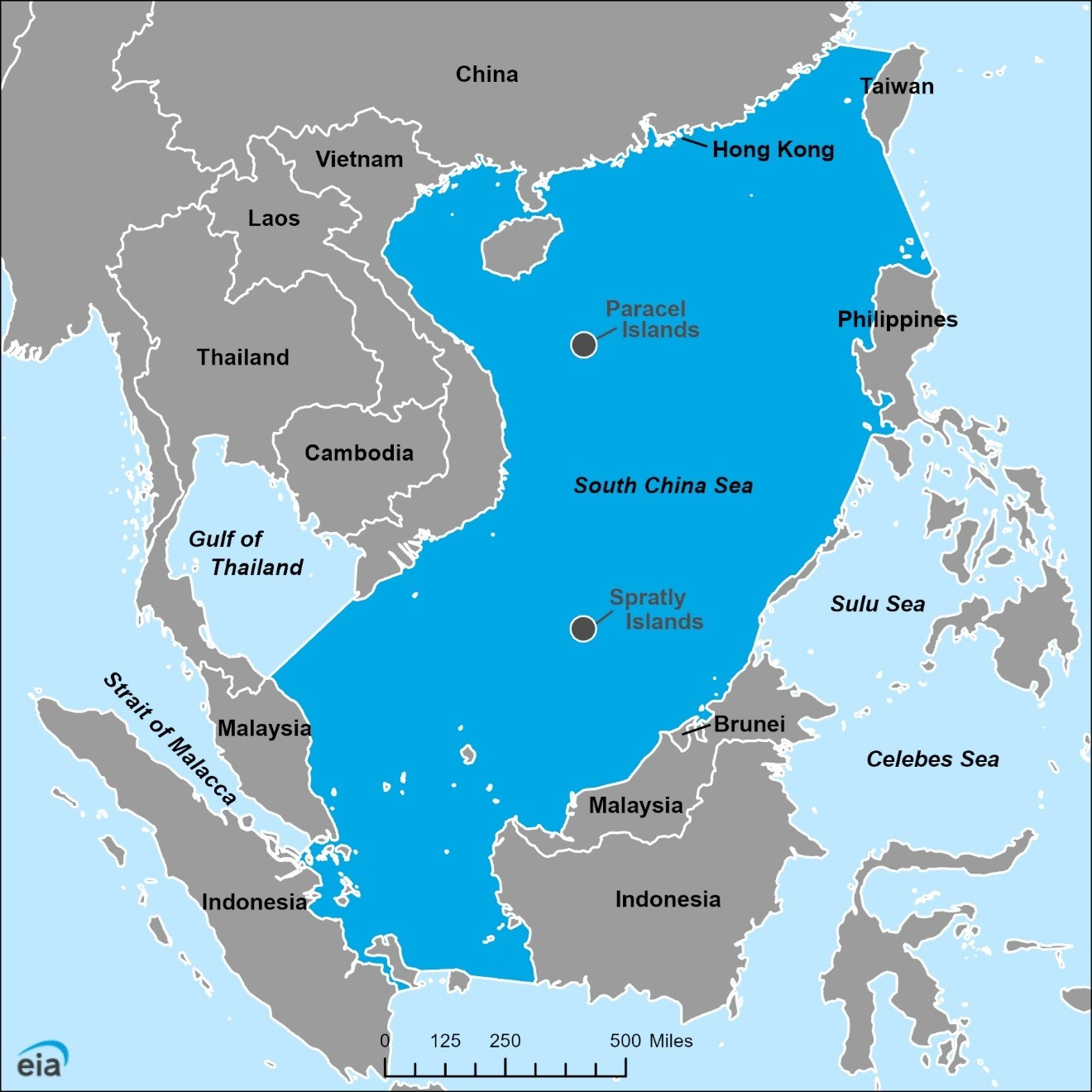
History is full of places dismissed as peripheral until power politics returned to them. Gibraltar was once just a rock. Singapore was once a remote colonial outpost. The Falklands were obscure islands until war restored their significance. Strategic geography often appears trivial until conflict makes it obvious. For the sake of our sanity, we will pass on discussion of Greenland and Cuba at this time as they are more nuanced and more vital as this policy matures.
Washington clearly recognizes the stakes. The United States has deepened military access, exercises, intelligence cooperation, and rotational presence across the Indo-Pacific arc. The Philippines has regained central importance. Taiwan has become the most sensitive geo-political policy issue in the world. Vietnam has edged closer to Washington without formal alliance. Indonesia matters enormously because of geography and sea-lane proximity. Japan and Australia remain foundational pillars, while India adds weight to the broader balance even without formal alignment.
No dramatic encirclement has been declared. But the cumulative effect is unmistakable. China increasingly confronts a map filled with friction points: island chains to the east, uneasy neighbors to the north, Indian Ocean concerns to the southwest, and renewed American partnerships among Southeast Asian states. This is how balancing works in practice—not through theatrical announcements, but through incremental constraints that complicate planning and slow expansion.
The United States has also embraced the role of disruptor in the South China Sea. Freedom of navigation patrols challenge excessive claims. Allied exercises demonstrate resolve. Intelligence operations map behavior. Support for smaller claimants prevents silent surrender through fatigue. The objective of these activities isn’t conquest, it’s a slow, steady denial of access. Every year China is prevented from converting economic scale into uncontested regional dominance is another year for coalitions to harden, supply chains to diversify, and Chinese internal constraints to deepen.
Seen through this lens, Iran is not disconnected from Asia at all.
If the U.S. is preparing for prolonged rivalry with China, it has good reason to reduce peripheral fires, stabilize energy chokepoints, reassure nervous partners, and preserve strategic bandwidth. Iran threatens all four. It can unsettle Gulf allies, pressure shipping, distort energy pricing, and consume diplomatic and military attention. In an earlier era of American surplus power, such chronic instability could be tolerated. But in the current era of renewed concentration, instability becomes more costly.
This is why the old model of managing Iran as a permanent irritant may be ending. For years, Tehran occupied a peculiar strategic space: dangerous enough to sanction, troublesome enough to justify regional presence, but manageable enough to avoid decisive confrontation. That ambiguity suited everyone more than they admitted. Iran could posture, Washington could contain, and the region could absorb periodic shocks.
Once open conflict begins, that equilibrium collapses and proxy management gives way to direct deterrence. Sanctions give way to force posture. Tactical patience gives way to timetable pressure. A state increasingly focused on a primary competitor becomes less willing to tolerate unresolved instability in secondary theaters.
Seen in this context, other recent and seemingly disconnected developments coalesce into a unified strategy. The color or soil and geographical distinctions may change but the policy remains. Pressure on Venezuela is not only about Caracas; it is also about denying Chinese footholds in the Western Hemisphere. Renewed interest in Greenland is not eccentric symbolism; it reflects Arctic routes, missile warning systems, and future resource competition. The strategic consequences of Ukraine weakened Russia, tightened NATO cohesion, and narrowed one pole of resistance while Washington’s gaze shifts increasingly toward another.
This does not require a secret master plan. Grand strategy rarely emerges that way. More often it forms through accumulation. Budgets shift. Bases move. Threat perceptions harden. Allies reposition. Industries reshore. Rivals overreach. Institutions adapt. Then observers suddenly notice a pattern that had been forming in plain sight. We may be living through such a moment now.
Old strategies, new technologies
Containment 2.0 is not a nostalgic replay of the Cold War. It is the adaptation of old strategic grammar to a new technological age. The first containment guarded borders. The second must guard systems. The first deterred armored columns. The second deters coercive dependence. The first relied on static blocs. The second depends on fluid coalitions, industrial resilience, maritime access, technological advantage, and control of strategic chokepoints.
Its instruments are therefore broader. Diplomacy builds balancing coalitions. Information shapes legitimacy. Military posture complicates aggression. Economic policy diversifies supply chains. Finance constrains access to capital. Intelligence maps vulnerabilities. Lawfare uses sanctions, export controls, and maritime rulings as strategic tools. Iran has become one arena where many of these instruments converge at once.
Many readers will resist this interpretation. They may prefer to see isolated wars, disconnected crises, and random overlaps. Sometimes those explanations are correct. Yet there are also historical moments when events across continents begin to rhyme, when separate headlines reveal the same deeper shift in power.
The war in Iran should therefore be read through two lenses simultaneously. The first lens shows missiles, militias, retaliation, and oil shock. The second shows demographics, supply chains, maritime chokepoints, alliance geometry, and the quiet preparation for a larger contest.
One lens explains the headlines.
The other explains the era.
Iran may be the crisis of the moment.
China remains the horizon.
If you want to continue your own research into the issues discussed in this blog, scroll down for a list of my sources and recommended reading.
A few weeks ago, I received this feedback from a Policy in Plain Sight reader:
“Your topics are timely and your background makes you qualified to inform both the general public and the subject matter experts in your field. Your take on topics was also refreshing. The Roe v Wade article was unique, and that’s what any audience wants. The surprise of, ‘I didn’t see that angle before.’”
I really appreciate when readers take time to write. Whether you agree or disagree with my takes, I welcome your thoughts and would love to hear your suggestions for future topics. If you aren’t already a subscriber, please sign up. It’s free and you’ll get my next post emailed to you as soon as it’s published.
Notes and sources
BlackRock-led Consortium. (2025, March 4). Acquisition of CK Hutchison canal-adjacent port assets in Panama. Reuters.
Center for Strategic and International Studies. (2026). Fragile U.S.-Iran ceasefire issues to watch. Washington, DC: CSIS.
Center for Strategic and International Studies. (2026). Visualizing Iran’s escalation strategy. Washington, DC: CSIS.
Center for a New American Security. (2021). How the Afghanistan withdrawal costs the U.S. with China. Washington, DC: CNAS.
Council on Foreign Relations. (2026). How the Iran war confirmed, contradicted, and complicated U.S. policy. New York, NY: CFR.
Council on Foreign Relations. (2026). Coercing Iran: Why the Hormuz blockade has a short fuse. New York, NY: CFR.
Council on Foreign Relations. (2026). U.S. continues economic and diplomatic pressure on Iran. New York, NY: CFR.
International Atomic Energy Agency. (2026). Verification and monitoring in Iran: GOV/2026/8. Vienna: IAEA.
Lowy Institute. (2025). Peak repayment: China’s global lending turns inward. Sydney: Lowy Institute.
National Bureau of Statistics of China. (2026). Statistical communiqué on the 2025 national economic and social development of the People’s Republic of China. Beijing.
National Defense University Press. (2020). Put the FIL into DIME: Growing joint understanding of the instruments of power. PRISM / NDU Press.
North American Aerospace Defense Command. (2026). NORAD conducts Operation Noble Defender in Pituffik, Greenland. NORAD.
RAND Corporation. (2025). Chinese interpretations of the Russia-Ukraine war and U.S. strategy. Santa Monica, CA: RAND.
Reuters. (2026, January 11). With Venezuela raid, U.S. tells China to keep away from the Americas. Reuters.
Reuters. (2026, March 21). China’s heavy reliance on Iranian oil imports. Reuters.
Reuters. (2026, March 27). Trump says Cuba is next in speech touting U.S. military successes. Reuters.
Reuters. (2026, April 13). China urges restraint over U.S. blockade of Strait of Hormuz, backs talks. Reuters.
Reuters. (2026, April 17). Ships crossing Hormuz need IRGC approval; unfreezing assets part of deal, Iranian official says. Reuters.
The Belfer Center for Science and International Affairs. (2026). The degradation of Iran’s proxy model. Cambridge, MA: Harvard Kennedy School.
The Brookings Institution. (2019). Containing Iran. Washington, DC: Brookings.
U.S. Census Bureau. (2024). Population estimates show growth driven by international migration. Washington, DC.
U.S. Department of Defense. (2022). 2022 National Defense Strategy of the United States of America. Washington, DC.
U.S. Energy Information Administration. (2024). China remains the world’s largest crude oil importer. Washington, DC: EIA.
World Bank. (Various years). World development indicators. Washington, DC: World Bank.
World Trade Organization. (2001). Accession of the People’s Republic of China. Geneva: WTO.
Further reading
Kennan, G. F. (1947). The sources of Soviet conduct. Foreign Affairs, 25(4), 566–582.
Kissinger, H. (1994). Diplomacy. New York, NY: Simon & Schuster.
Kaplan, R. D. (2012). The revenge of geography: What the map tells us about coming conflicts and the battle against fate. New York, NY: Random House.
Mahan, A. T. (1890). The influence of sea power upon history, 1660–1783. Boston, MA: Little, Brown and Company.
Spykman, N. J. (1942). America’s strategy in world politics: The United States and the balance of power. New York, NY: Harcourt Brace.
Brzezinski, Z. (1997). The grand chessboard: American primacy and its geostrategic imperatives. New York, NY: Basic Books.
Allison, G. (2017). Destined for war: Can America and China escape Thucydides’s trap? Boston, MA: Houghton Mifflin Harcourt.
Friedman, G. (2009). The next 100 years: A forecast for the 21st century. New York, NY: Doubleday.
Huntington, S. P. (1996). The clash of civilizations and the remaking of world order. New York, NY: Simon & Schuster.
Luttwak, E. N. (2012). The rise of China vs. the logic of strategy. Cambridge, MA: Belknap Press.
This is a really well thought out critique, especially the point that “Containment 2.0” might be less a rethink than a rebranding of old assumptions. The reminder that Cold War containment wasn’t as restrained or clean as it’s often remembered is important, and it’s easy to see how similar framing today could lead to the same kinds of blind spots.
What does the alternative looks like in practice? If you move away from containment as a guiding framework, how do you handle genuinely adversarial behavior without slipping into either escalation or passivity? It feels like the hardest part isn’t diagnosing the problem, but defining a strategy that avoids those historical pitfalls while still dealing with real-world constraints.
Thanks for taking the time to read for those who did. Interested in all feedback.