

In August 2021, America ended its longest war in scenes that felt both abrupt and unfinished. Bagram Airfield went dark. Kabul fell within days. The Taliban inherited a capital — and an arsenal.
The question has lingered ever since: Was the withdrawal simply collapse and miscalculation, or was it also a strategic trade in which speed and reprioritization outweighed the cost of what was left behind?
Images of Taliban fighters carrying American rifles and driving U.S.-supplied vehicles hardened suspicion in the public mind. The rapid closure of Bagram, the consolidation to a single civilian airport and the disintegration of Afghan security forces created an outcome that felt less like an orderly exit and more like abandonment.
The official record describes flawed assumptions and rapid collapse. But the broader strategic context complicates the story.
By 2021, the United States had spent more than $2 trillion on the war. Tens of billions had gone into equipping and training Afghan forces. Much of the materiel later captured — Humvees, MRAPs, small arms, night-vision equipment — had been transferred years earlier. In legal terms, it was Afghan government property. In strategic terms, it became leverage the moment Afghan forces evaporated.
Retrieving that equipment would have required reopening supply corridors or sustaining large-scale airlift, securing dozens of bases and redeploying thousands of troops for months. Holding Bagram, the most defensible installation in the country, would have meant maintaining a visible military footprint and accepting renewed combat risk. Instead, it was vacated weeks before Kabul collapsed.
Why close Bagram first rather than last?
One explanation is force protection and political finality. Another is strategic alignment. In 2018, the National Defense Strategy formally declared China the pacing threat. By 2021, the United States was reallocating military focus toward the Indo-Pacific. Naval deployments intensified in contested waters. The Marine Corps restructured for littoral operations. Afghanistan no longer defined the future balance of power.
If the choice was between spending months retrieving aging counterinsurgency equipment or accelerating a pivot toward great-power competition, speed carried strategic value. The equipment left behind was tailored for rural insurgency, not high-end peer conflict. The opportunity cost of recovery included time, lift capacity and sustained exposure in a theater leadership had judged misaligned with future priorities.
Yet Afghanistan did not become irrelevant. It changed domains.
Geographically, Afghanistan sits at the crossroads of Central Asia, South Asia and the Middle East. It borders Iran, Pakistan and the former Soviet republics, and touches China’s Xinjiang region. That positioning gives it potential relevance beyond war.
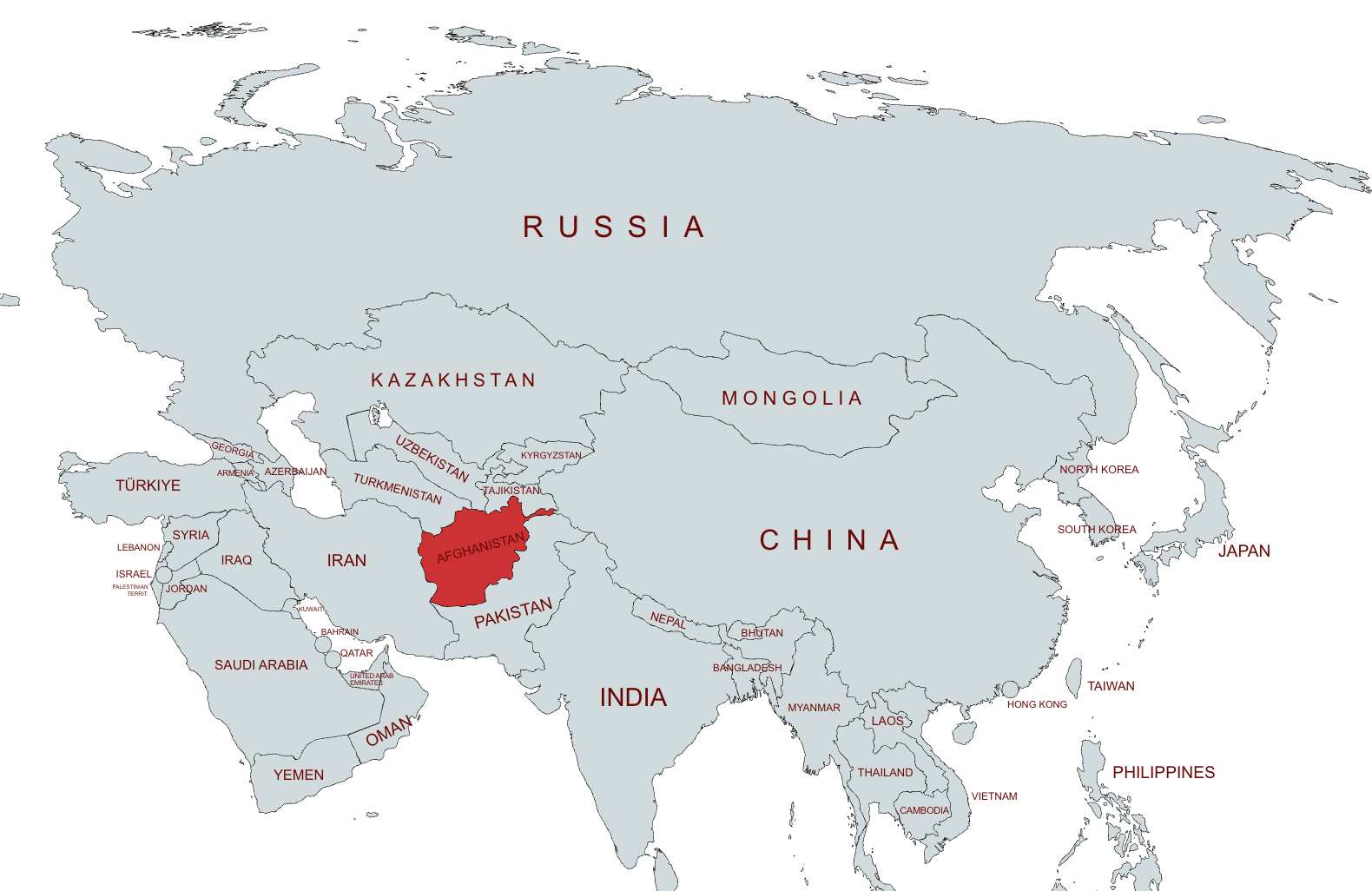
For China’s Belt and Road Initiative, Afghanistan represents connective territory. Beijing has discussed extending the China-Pakistan Economic Corridor into Afghanistan, linking western China to Central Asian and Middle Eastern markets. Rail concepts envision Afghanistan as a transit hub rather than a peripheral state. In May 2025, during a trilateral meeting in Beijing involving the foreign ministers of China, Pakistan, and Afghanistan, the parties agreed to extend the China-Pakistan Economic Corridor (CPEC) into Afghanistan to enhance trilateral cooperation and economic connectivity.
Afghanistan’s spot right in the middle of Central Asia, South Asia, and the Middle East makes it a goldmine for China’s BRI — it’s the perfect land bridge to link CPEC straight through to resource-rich Central Asia and warm-water ports, dodging chokepoints and shortening supply lines for energy and goods. Beijing sees it as a way to lock in influence, tap those untapped minerals, and build a buffer against unrest spilling into Xinjiang. So yeah, why hand over Bagram — a base that’s literally hours from China’s nuclear sites and gives eyes on Russia, Iran, and the whole region — unless the plan was to step back, let the Taliban run things with promises of autonomy, and keep some leverage through the flood of humanitarian cash that props up their regime without boots on the ground?
Beneath its terrain lie substantial mineral deposits: Copper, iron ore, lithium and rare earth elements. Lithium has become strategically significant amid the global transition to electric vehicles and battery storage. Copper and rare earths underpin electrical infrastructure and advanced manufacturing. Chinese firms have expressed interest in mining concessions, though implementation has been slow due to security and political constraints. China’s engagement has intensified in recent years, with high-level talks in August 2025 where Chinese Foreign Minister Wang Yi visited Kabul and expressed keen interest in exploring and mining Afghanistan’s minerals, pledging to initiate practical mining activities that year and urging formal Afghan participation in the Belt and Road Initiative. Analysts note that Afghanistan’s lithium, copper, and iron deposits could bolster Beijing’s supply chain security for batteries and infrastructure, though progress remains hampered by instability. Earlier deals, such as contracts worth billions for copper, gold, iron, and other minerals involving Chinese partners, have been announced but face delays.
Recent events underscore the volatility surrounding those ambitions.
In January 2026, an Islamic State-Khorasan Province suicide bombing targeted a Chinese restaurant in Kabul, killing several people, including at least one Chinese national. The attack highlighted the vulnerability of Chinese citizens operating in Taliban-controlled territory. Earlier that month, China and Pakistan publicly urged the Taliban government to curb extremist groups operating from Afghan soil, signaling Beijing’s expectation that economic engagement must be matched by security control.
These developments place Afghanistan squarely within evolving great-power competition. China seeks infrastructure access and resource security. Russia has shown renewed regional interest. The United States has shifted military focus but remains strategically engaged in countering Beijing’s global expansion.
Within that context, the 2021 withdrawal takes on broader meaning. The rapid departure removed U.S. forces from direct entanglement while leaving behind equipment and territory that now sit at the intersection of mineral wealth, transit potential and geopolitical rivalry. Additionally, post-withdrawal U.S. humanitarian aid — totaling billions since 2021 and channeled largely through UN agencies and NGO — has indirectly (possibly deliberately) supported Taliban-controlled governance by sustaining essential services and injecting cash into the economy, with reports of Taliban benefiting through taxes, fees, or diversion.
Some observers note that instability in Afghanistan could complicate China’s ambitions. Extremist attacks against Chinese nationals introduce friction into Belt and Road expansion. Whether such instability is merely residual chaos or an indirect feature of broader competition remains unclear. There is no public evidence linking the withdrawal to a deliberate effort to shape that dynamic. But the convergence of timing, geography and rivalry invites scrutiny.
Afghanistan has long been terrain where major powers reassess strategy. The Soviet Union withdrew in 1989, leaving behind matériel and instability. Decades later, the United States departed under different conditions but amid similar global recalibration. In both cases, departure did not erase Afghanistan’s strategic relevance; it repositioned it.
Did 2021 represent collapse, reprioritization or repositioning? Were equipment losses accepted as the cost of pivoting toward China? Could Afghanistan’s instability now function, intentionally or incidentally, as friction within Beijing’s regional ambitions?
The record offers facts, timelines and incentives, but not definitive intent.
Bagram closed. Kabul fell. Equipment remained. China explored infrastructure and mining ties. Extremist violence targeted foreign nationals. Regional powers demanded security assurances.
The war ended. The strategic competition did not.
Geography persists. So do interests.
Very well written and informative. Biased off of your research on the topic, I would like to know your hypothesis of why we left.
Interesting assessment of opportunity costs. I understand not hauling the equipment back to another friendly location. But, why didn’t we render the equipment useless? That could have been done.